US President Donald Trump has renewed his push to restrict birthright citizenship in the United States, signing a new executive order aimed at people who allegedly travel to the country under the guise of tourism with the intention of giving birth there.
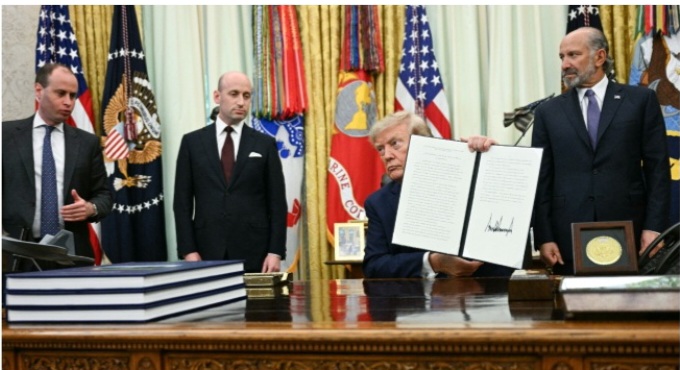
Trump signed the order on Thursday at the White House, arguing that birthright citizenship has been abused and describing the practice as unfair.
“They’ve taken birthright citizenship, and they’ve made a joke out of it,” Trump told journalists in the Oval Office.
The latest move comes weeks after the US Supreme Court struck down an earlier attempt by the Trump administration to restrict the constitutional right. Trump described that ruling as “very unfortunate” and said his administration was making adjustments to pursue the policy.
The new order seeks to address what the administration describes as “birth tourism”, where foreign nationals travel to the United States ostensibly as visitors but allegedly do so primarily to give birth and secure US citizenship for their children.
Trump said the administration was determined to prevent what he considers an abuse of the country’s citizenship laws.
Stephen Miller, a senior adviser to Trump, said the order would also target other categories of people whom the administration believes should not automatically qualify for birthright citizenship.
According to Miller, this could include children of members of foreign terrorist organisations and certain individuals who lobby or act on behalf of foreign governments.
He said the move was intended to ensure that people who “wrongly” receive birthright citizenship would no longer qualify for the benefit.
Trump had issued another executive order last year seeking to deny automatic US citizenship to children born in the country to parents who were either in the US illegally or staying temporarily on visas.
However, lower federal courts blocked the policy, ruling that it conflicted with the Citizenship Clause of the 14th Amendment to the US Constitution.
The amendment states that all persons born or naturalised in the United States and subject to its jurisdiction are citizens of the country.
The Supreme Court later intervened in the case, with Chief Justice John Roberts writing the majority opinion. The ruling was supported by two other conservative-leaning justices and the court’s three liberal justices.
The 14th Amendment provides a constitutional basis for birthright citizenship, although there are already exceptions under US law.
For instance, children of foreign diplomats are generally not covered because their parents are not considered subject to US jurisdiction in the same way as ordinary visitors.
US immigration rules also allow authorities to deny visas where there is evidence that an applicant’s primary purpose for travelling to the country is to give birth.
The Trump administration has previously argued that the phrase “subject to the jurisdiction thereof” in the 14th Amendment excludes children whose parents are undocumented migrants or visitors on temporary visas.
That interpretation, however, has faced significant legal challenges.
Trump’s renewed action forms part of his broader immigration agenda, which includes efforts to deport undocumented migrants, tighten immigration controls and remove certain deportation protections.
The latest executive order is also expected to face further legal challenges over whether the president has the authority to alter a citizenship right established by the US Constitution.